
Subdomain or Subdirectory? Why This Blogging Decision Matters More Than You Think
Before you sign a contract with any SEO agency, ask one deceptively simple question: “Where will you host our blog, on our main domain or on a subdomain?” The answer, and how confidently the agency explains it, tells you a great deal about whether that agency understands how search engines actually work.
This is one of the oldest debates in technical SEO, and it still trips up small business owners who are trying to evaluate proposals from competing agencies. Below, we break down the subdomain versus subdirectory question in plain language, so you can walk into any agency conversation prepared to ask the right follow up questions.
Subdomain vs. Subdirectory: What’s the Actual Difference?
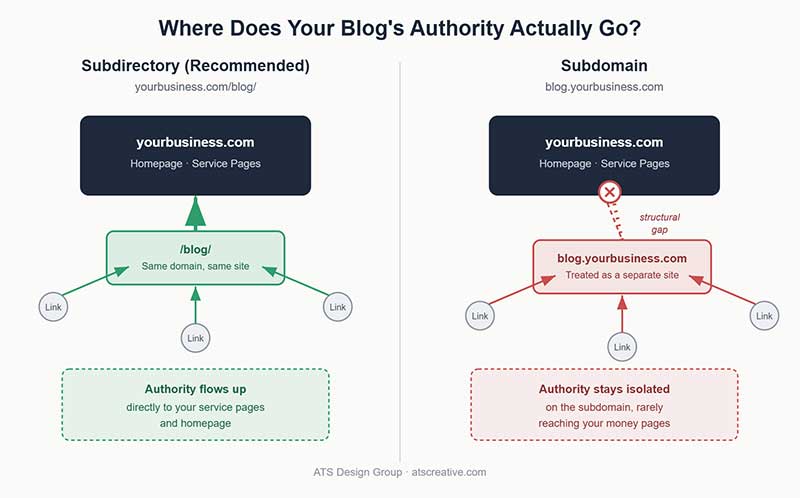
A subdirectory (also called a subfolder) places your blog inside your existing website’s structure, using a URL like yourbusiness.com/blog/. Every page under that folder is part of the same website as your homepage and your service pages.
A subdomain places your blog on what search engines treat as a distinct address, such as blog.yourbusiness.com. Visually it can look similar to your main site, but structurally it behaves more like a separate, almost disconnected property.
The distinction sounds technical, but it has realworld consequences for how quickly your website builds authority, how well your service pages rank, and how easily potential customers move from reading your content to contacting your business.

What Google Actually Says (and What Actually Happens)
Google’s own guidance, repeated over the years by Search Advocate John Mueller, is that its systems are technically capable of handling subdomains and subdirectories equally well. That statement is true, and it’s also incomplete if you are running a small business in Syracuse or Camillus or Fayetteville, and trying to effectively compete locally.
Mueller has also said, in the same breath, that he generally recommends keeping related content together on one site rather than splitting it across a subdomain, reserving subdomains for content that is genuinely different from the main site. That second half of the guidance is the part small business owners rarely hear about, and it is the part that matters most in actual practice.
In other words: Google’s crawlers can technically read a subdomain. Whether that structure actually helps your business rank and generate leads is a separate question, and the practical, real-world evidence points clearly toward one answer.
Why a Subdirectory Blog Usually Wins for Small, Local Businesses
It Consolidates Your Authority Instead of Splitting It
Every time another website links to one of your blog posts, that link carries a small amount of trust and authority with it. When your blog lives in a subdirectory, that authority flows directly into your main domain, lifting the ranking power of your commercial pages along with it.
When a blog lives on a subdomain, Google frequently evaluates it as a separate entity. Backlinks earned by blog posts can stay isolated on the subdomain instead of strengthening the pages that actually generate revenue, your service pages, your location pages, and your homepage.
For a small business with limited content and limited link building resources, this difference is not minor. You cannot afford to build authority twice.
It Builds One Unified Knowledge Base, Not Two
Search engines and AI answer engines alike are increasingly evaluating entire websites as cohesive knowledge bases rather than judging isolated pages in a vacuum. When your blog and your service pages share one domain, every article you publish reinforces the same topical footprint, making it easier for both traditional search and AI-driven tools to recognize what your business does and where it operates.
Split that structure across a subdomain, and you are effectively asking search engines, and AI systems that cite sources for tools like ChatGPT and Perplexity, to build trust in two separate entities instead of one.
It Keeps the Reader (and the Sale) in One Place
This part has nothing to do with algorithms and everything to do with people. When a blog shares your website’s header, footer, branding, and navigation, a reader who finds your article can move to a service page or a contact form without ever feeling like they left your site.
Subdomains often introduce friction here, sometimes because they run on different software, sometimes simply because the visual experience feels slightly detached from the main brand. Every bit of friction is a chance for a potential customer to leave before they ever reach a call to action.
Are There Legitimate Reasons to Use a Subdomain?
Yes, and a good agency will tell you this because the answer is not always the same. Subdomains still make sense for tools, applications, or platforms that are functionally separate from your core website, such as a client portal, a booking system, or a staging environment used during development. The deciding factor is whether the content is genuinely different from what your main site does, not whether a developer finds it easier to set up.
A blog written to support your services and attract local customers is not one of those exceptions. It is core marketing content, and it belongs on your main domain.
The Real Question to Ask Your SEO Agency
Any agency that recommends a subdomain for your business blog, without a specific technical reason tied to your situation, is either unfamiliar with how link equity and crawl context work in practice, or is prioritizing convenience over your results. Neither is a great sign.
The stronger question to ask isn’t just “subdomain or subdirectory,” it’s “how will our blog content support our service pages?” A capable agency should be able to describe how blog posts will internally link to the commercial pages you actually want to rank, using natural, descriptive language rather than generic phrases like “click here.”
How This Plays Out on Our Own Website
We apply this same principle to our own site. Every article we publish lives in a subdirectory, and every article is built to support a specific commercial page rather than compete with it for the same searches, a problem known as keyword cannibalization. If you’d like to see the strategy in action, our SEO services page outlines how we structure local SEO campaigns, from on-page targeting to the internal linking strategy that connects our educational content back to the pages that actually generate leads for our clients. You can also learn more about Google’s own guidance on site structure directly from Google Search Central.
Frequently Asked Questions
Does Google penalize businesses for using a blog subdomain?
No. Google does not apply a direct ranking penalty for using a subdomain. The disadvantage is indirect: a subdomain typically does not inherit your root domain’s backlink history and internal link equity as efficiently as a subdirectory does, which can slow down how quickly your service pages build authority.
Is it worth moving an existing blog from a subdomain to a subdirectory?
Often, yes, though the migration needs to be handled carefully with proper redirects to avoid losing existing rankings. Ask any agency proposing this move how they plan to handle the technical transition before you commit to it.
Does this apply to every small business website?
For most local service businesses, keeping the blog on the main domain is the safer, more effective choice. The exception is when the content is genuinely a separate product or platform, such as a member portal or an unrelated tool, rather than marketing content meant to support your services.
For comprehensive technical audits and architecture strategy, explore our core SEO Services., or reach out with any questions or concerns you may have about your own situtation.


